Monday, May 23, 2011

What are the UK papers saying?


Mobile phones
The technology could soon be used to pay for items such as train tickets, and parking fees. 
The UK’s biggest mobile phone companies have launched the first payment scheme allowing customers to pay through their mobile phone accounts.
The new PayForIt technology allows mobile phone customers to credit small purchases up to £10 to their mobile phone accounts, a scheme likened to turning mobile phones into 'digital wallets'.
The system works on the basis that the mobile phone networks have already stored all the details needed for a payment.
When users find content they wish to purchase on a PayForIt-enabled website, they can select to have the amount credited to their bill.
Industry experts expect the technology to be used at first for digital items, including music and video downloads.
Companies already signed on to the scheme include MTV, Samsung, Sony Ericsson and ITV Mobile.
However Anuj Khanna from Tanla Mobile - an accredited PayForIt intermediary - said it was hoped the technology would soon be used to pay for items such as train tickets, congestion charging, parking fees or cinema tickets.
He said the scheme would fill a gap in the market, allowing customers to charge smaller amounts they were reluctant to put on their credit cards.
“You could be on your way to the cinema on the bus on in the car, and you could click and buy your ticket through your phone. It's like PayPal on your phone,” he said.
“This is creating a new market for small transactions using your phone. It’s a market that has been eyed by all the major banks for a long time but they have not been able to come up with a product.”
First announced in March 2006, the PayForIt scheme has been developed by Vodafone, Orange, Three, O2 and T-Mobile.
Mr Khanna said the technology had been gradually rolled out this year, and was being officially launched this month.
The technology had been developed as an alternative to systems such as premium rate SMS, which he said was not highly regarded as a mobile payment system.
Megan Levey (2007). The Telegraph. Mobile phones to be used as 'digital wallets'. Retrieved from http://www.telegraph.co.uk/news/worldnews/1562029/Mobile-phones-to-be-used-as-digital-wallets.html
Mr Graham was keen to stress that 2 ergo was introducing a scheme that would help protect mobile phone users from some of the more unscrupulous premium service operators in future.
Many consumers subscribe to paid mobile services, such as news updates or music downloads, on the pretence that it is a one-off commitment. But they soon find out that they have unwittingly signed up for a regular and expensive service.
He said that 2 ergo's Payforit scheme would help to restore trust by ensuring that users actively consent to pay for a service every time before they can be billed.
Ben Bland (2007). The telegraph. Phone-in scandal dents trust towards mobile downloads. Retrieved from http://www.telegraph.co.uk/finance/markets/2809356/Phone-in-scandal-dents-trust-in-mobile-downloads.html

2ergo

Strange name, interesting company. The mobile phone technology group this week launched the UK's first payment scheme through mobiles, to be called Payforit.

The new technology allows users to buy goods and services from the internet via their mobile and charge them to their phones without the need for a credit card.
The system works on the basis that the mobile phone networks have already stored all the details needed for a payment, so the user merely needs to enter a Pin to complete the transaction, giving extra security.
2ergo is the first British intermediary in the UK to establish so-called "billing connects" with multiple mobile networks, namely Vodafone, Orange and T-Mobile.
The company, which floated on Aim in March 2004, is focused on providing technology to mobile phones, and its core business sprang from providing the technology that allows additional paid-for content to be downloaded on to mobiles.
These days it offers a multiserve platform, and has also expanded well in the US, where acceptance levels of content have continued to grow.
Analyst Mike Allen at broker Numis Securities was forecasting a profit of £2.1m to August 2006, giving earnings per share of 5.7p, and that was before this latest announcement. It is expected the benefits of Payforit will not flow through until the next financial year.
Based on its recent 216½p share price, 2ergo sits on a current price-earnings multiple of 38 times, dropping to 36.6 times by August 2007.
That may not be cheap, but the company is an interesting play on a growing sector, and is well worth further investigation.

Rightmove

Home condition Reports were due to be 50pc of the cost of the Home Information Pack, so those who were gearing up to make money from providing them could lose out now that they have been abandoned. The market certainly seems to think so, knocking 20pc off the value of Rightmove's share price in one day.
Panmure Gordon's Alex deGroote immediately slashed the value of HIPs to Rightmove from £180m to zero, reducing his sum of the parts valuation from 425p to 310p. With shares trading at 280¾p on Wednesday evening, that suggests there is still limited value, and it may be a good time to reduce the average cost of your holding if you took Questor's earlier optimistic advice to buy at 390p. Rightmove's trading statement was encouraging, and it is important to remember the value of its website. 

James Quinn (2006). The telegraph. The Questor column. Retrieved from http://www.telegraph.co.uk/finance/markets/questor/2943939/The-Questor-column.html

Bango - selling the idea to merchants

Bango - pay for it 3.0 a guide to mobile payments in the UK

Does it affect me?

If you are selling digital content to consumers in the UK using Premium SMS or via a mobile phone through a web
site (WAP) then Payforit is important to you. In addition to compliance with the UK rules, Payforit could bring you: higher earnings; more successful mobile transactions; happier customers that come back and spend more money more often; and lower customer care costs with reduced refund requests.

What will happen if I am not Payforit compliant?

If you are selling mobile content or services in the UK with operator billing you need to be Payforit compliant. Payforit is now fully mandated by all the UK mobile operators for all mobile web payments and failure to comply will result in your service being switched off.


Reliance on small print

The mobile industry provides clear and concise Best Practice guidelines for services using SMS,
but the consumer needs to read and understand the terms either from a text message sent to their
handset or on the print of the original advertisement. With the WAP presentation, the
consumer is advised of all the terms of sale onscreen immediately before they are billed without
having to refer to separate messages or the original ad. This removes any possible confusion,
improves the customer’s experience and increases the likelihood of repeat purchases. It also
significantly reduces the number of customer care issues.


Get started and start selling in minutes

If you are not Payforit compliant, you need to act quickly.  Bango Payment UK has been designed to help you get up and running with a full Payforit compliant service.  It provides all the benefits of our full global payment solution, but focused on delivering the best payouts and consumer conversion rates in the UK.  Call our Sales team on +44 845 075 3663, learn more or sign up online at www.bango.com
Try us out for free Still not sure? Got ten minutes to spare? Then give Payforit a try – see how quick and simple Bango Payment is by road-testing our free payment 30 day trial. Visit www.bango.com/payment for more details.

Bango (no date). Bango - pay for it 3.0 a guide to mobile payments in the UK. Retrieved from http://bango.custhelp.com/ci/fattach/get/152896/1304433863/redirect/1/session/L2F2LzEvdGltZS8xMzA2MjAyMTM1L3NpZC9kc1M2aEp1aw==

Pay for it - what do they say about it?

Payforit, the easy way.

Welcome

Payforit is the new payment service, supported by all licensed UK mobile operators, designed to make it easy to pay for low cost services on the mobile phone.
First announced in March 2006, the Payforit scheme has been developed by the operators to promote a trustworthy and consistent standard for paying by mobile, so that consumers can buy with confidence when they are making one-off payments or setting up subscription services via their phone.

With Payforit, consumers don’t need a credit card or bank account to use the service – they don’t even need to sign up or register any details.  All they need is their mobile phone.
The UK licensed mobile network operators have accredited a number of Payment Intermediaries across a differing range of criteria for their suitability to operate a trusted payment scheme to ensure that the best interests of mobile consumers are protected while conducting online purchasing.  These Accredited Payment Intermediaries ensure that transactions are managed and processed in accordance with the Payforit Scheme Rules.
This will ensure that the payment experience for consumers is consistent, transparent and user-friendly at all times.  These improvements in user experience will help instil consumer confidence in paying by mobile, generating repeat business and improved conversion rates for merchants.

Initially, Payforit will support micropayments (generally <£10) for services purchased on mobile portals, providing a quick and simple billing option and potential access to over 52 million users* in the UK.  From May 2007 Payforit has been extended to support web transactions also, opening up new revenue streams for many merchants.

Payforit (2010). Pay for it, the easy way. Retrieved from http://www.payforituk.com


2. How does it work?
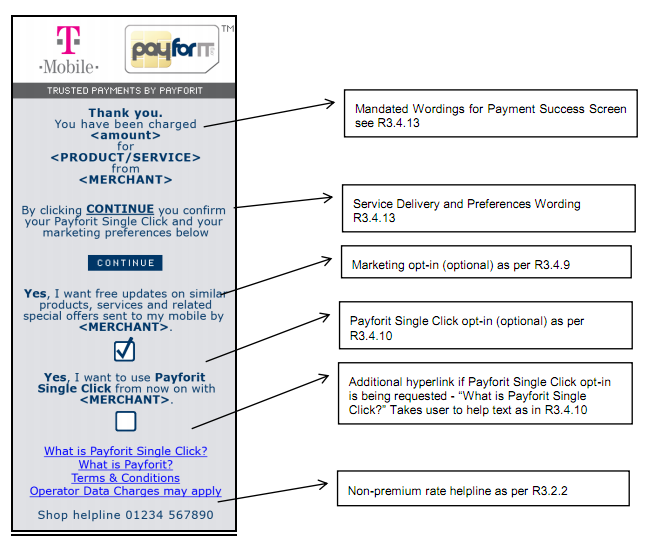
Whenever you want to purchase content and charge it your mobile, you will be presented with a standard Payforit screen that includes clear information on the content/service you are buying, the merchant you are buying from and how much it will cost you. Once you authorise payment by pressing ‘Pay Now’ or ‘Subscribe’, a payment request goes directly to your mobile operator for validation.


4. What are the benefits of using Payforit?
Payforit has been designed to be very simple to use, meaning you can charge items directly to your mobile in a matter of seconds.  There’s no need to send Premium rate text messages to complete a purchase, making it extremely easy and convenient to buy content and services from the mobile internet.


5. Do I need to provide any personal details?
No.  What’s more, you don’t even need to type in your mobile number when you are browsing and shopping on the mobile internet – Payforit automatically detects your number from your mobile network as soon you reach the payment page.


7. Do I need a bank account or credit card to be able to use Payforit?
There’s no need for a bank account or credit card.  Any purchases you make will be charged directly to your monthly phone bill, or deducted from your prepaid credit.


8. Do I need to pay anything for using Payforit?
There are no additional charges for using Payforit, you only pay the price of the content you are purchasing*
*Please note, for downloads, as well as the price of the service you have ordered, you will also be charged browsing costs in accordance with your Operator data tariff.


9. Do I need to sign up for Payforit with my mobile operator?
No, there’s no need to sign up to be able to use the service.  Whenever you see the Payforit symbol on a mobile portal, you simply follow the on screen instructions to pay for your content.


11. Is there a maximum amount for individual Payforit transactions?
Payforit has initially been designed to support low value transactions (‘micropayments’), typically less than £10.


Payforit (2010). Frequently asked questions. Retrieved
 from http://www.payforituk.com/pages/faqs.html#4


The Trusted Mobile Payment Framework exists to promote a safe and trustworthy environment under which mobile phone users may purchase goods and services and charge  the cost  to their mobile phone accounts. It has been constructed under the auspices of the Mobile Network Operator Payforit Management Group („Payforit Management Group‟).


3.7 Payforit Single Click Processing Rules Payforit.
Single Click purchasing is an optional extension to the Payforit scheme that allows for Consumers to choose a more rapid payment method for multiple purchases from the same Merchant on WAP.  The  Consumer must be initially taken through the full Payforit payment flow before they are presented with the option to use Payforit Single Click for their next purchase(s) from the  same Merchant. The sign-up to Payforit Single Click is done on the Payment Success Screens templates using option 5 or 6 (as per R3.4).
Once the  Consumer agrees to use Payforit Single Click for future purchasing  from that Merchant, the Accredited Payment Intermediary will present a small clickable image containing the price of the item directly into the Merchant‟s screen, requiring the  Consumer to click the image to confirm the charge to their account.


Payforit (2010). Trusted Moblie payment framework. Scheme rules. Retrieved from http://www.payforituk.com/docs/Payforit%203.0%20Published%2026%2002%2010.pdf

Sunday, May 22, 2011

Children's interaction with mobile phones

Children get first mobile phone at average age of eight
Eight is the average age at which children are given their first mobile phone, according to a survey.

Children get first mobile phone at average age of eight

Its survey also found that three-quarters of all children aged seven to 15 owned "at least" one mobile.
The charity's survey highlighted how early children now become financially aware – with peer pressure forcing them to get to grips with money to afford mobile phone ringtones, call costs and computer games.

It found that children as young as seven were offering to do chores in exchange for cash to buy ringtones.

But researchers were also told that by the age of 10, children were shopping online using their parents' debit or credit cards.
A third of children (32 per cent) have used the internet to buy computer games.

A quarter of the 546 children surveyed have voted in television competitions, which can often cost £1 or more to enter.

But only 18 per cent have bought a book online.

Wendy van den Hende, chief executive of the charity, said: "Children today face a kind of 'technological tipping point' forcing them to develop financial awareness at an earlier age.

"It is therefore, vital, that they are equipped with the skills and judgment to make sound decisions about money management from an early age."

The research also found that average weekly pocket money now stands at £6.32.

The online survey carried out by Populus questioned 1,435 people including 546 children aged seven to 15, 676 parents and 759 grandparents between January 16 and 26.

Stephen Adams (2009). 
The Telegraph. Children get first mobile phone at average age of eight. Retrieved from http://www.telegraph.co.uk/technology/news/4680507/Children-get-first-mobile-phone-at-average-age-of-eight.html 

The press - 2010

Parents on the other hand (at least, the group spoken to for this article) seem to have quite strong feelings about the right age, with 13 being the average age most seem comfortable to let their children have greater independence in their use of cellphones and the internet.

You only need to spend a short time with a group of 11 to 12-year- olds, however, before you'll find that cellphone use and texting is a huge part of their social lives - for the many who have phones.
Ask kids aged six and up, and you'll find many have email accounts and belong to online clubs that are junior versions of social-networking sites.
As for Facebook, it's not unusual to find 11 and 12-year-olds with a Facebook page, even though that means they've had to be less than truthful about their age - Facebook requires that you state your age is 13 before you can sign up.
Much like liquor sites. You can easily lie to say that your 18, when your not. If it can't be patrolled why make the rules?
Mostly, parents are positive about the benefits of technologies such as cellphones - being able to keep in touch with their kids was seen as a major benefit by all the parents interviewed.
But the capacity for bullying through texting, and the loss of privacy through the posting of photographs on social-networking pages, is the flipside that has many parents concerned.
Researchers such as Associate Professor Geoff Lealand, Screen and Media Studies, University of Waikato, caution against over- reacting. He urges parents to tread softly with their desire to control their kids' use of technology. "Strict, inflexible rules tend to be counter- productive and can increase the allure of 'forbidden' technology," says Lealand. "Better to be open and fair-minded about it - and acknowledge that your children are often more at ease and competent with technology than you are."
Similarly, Martin Cocker, executive director of NetSafe New Zealand, says that "protective mechanisms (of which denying access is the most basic) have limited value as safety tools".
Netsafe is a non-profit organisation that promotes safe and responsible use of cyberspace, and Cocker says the best path for parents is to educate their kids about the benefits and downsides of each technology. Parents should play a supervisory role while their kids are young, preparing them to make good decisions when they're old enough to be independent.
Meanwhile, your offspring will undoubtedly have a wide array of tech skills to teach you in return.
Cellphones
Parents and experts made clear distinctions here - it all depended on how the phone was used.
Parents all said cellphones were OK for their kids from whatever age they were first out and about on their own and might need to contact their parents. One family had a "family cellphone" which the nine or 11-year-old could use if they were out on their own.
A survey at one local school recently reported that 60 per cent of the year seven and eight children had a cellphone. Many of the parents interviewed for this article however felt high school, or age 13, was the more appropriate time for kids to have their own phone.
All parents expressed concern about the risks of text bullying. One mother said she wanted to hold off as long as possible from her 11-year-old having her own phone. She said face-to-face contact was the best way for kids to have contact with their friends. Other parents said texting was an inevitable part of their children's social lives and the important thing was that they knew how to text responsibly.
As for Martin Cocker from NetSafe, he says cellphones can play an important safety role, but the flip side is that the phones can be used to bully others.
"The question is not so much about access to a phone, but when a child is old enough to have their own private mobile phone."
And as for web-enabled phones, they are "definitely not for young children - if you don't think your child is old enough to have a computer in their room - you shouldn't be giving them a web-enabled phone".
Email accounts
As one mum put it, email is the new postal system, so it's hard to argue for restrictions. She let her children have email accounts from age six up. Other parents, however, said their kids were aged up to 13 before they got an email address. Given so much work is increasingly web-focused at primary schools however, an email account for pre-teens will be increasingly common.
As Geoff Lealand of Waikato University says, an email account is "pretty much a necessity, from primary school age, to assist with study and homework and generally connecting with a world beyond their usual experience.
"But they often need guidance in making judgments and evaluating content."
Martin Cocker of Netsafe, too, says children should have access to free email accounts as soon as they are "technology literate". Parents could help by setting up email accounts for their children and helping them learn how to manage them. It was a good idea to talk to kids about appropriate use.
Facebook
When is the right age for a social- networking page such as Facebook? According to Facebook, age 13. But all you need to do to get a Facebook page is to say you're at least 13 (even if you are not) so there are many under- 13s with a profile. Geoff Lealand from Waikato University says the minimum age set by Facebook seems reasonable.
Parents interviewed for this article also felt that 13 should be the minimum age. One dad said he thought social-networking sites were a poor way of socialising; and that it was too easy to write hurtful things or be hurt. "You don't want your kids to be part of a mob, or be victims. Young ones don't have the skills to sniff out when things are turning nasty."
But among parents and researchers there's also a certain acceptance that if kids want to use social-networking sites, they will - with parents' permission or not.
So if you have a child using Facebook, the key thing to do is talk about their privacy settings. Facebook, for example, lets you limit access to your account to only people whom you've accepted as friends - a better option than allowing open access for anyone, anywhere to browse through your social life.
And make sure you talk about possible consequences - a teacher trainee in Pennsylvania in the United States posted a picture of herself on MySpace with a plastic cup in her hand and wearing a pirate hat, with the caption "Drunken Pirate".
The educational institution where she was enrolled decided the photo promoted drinking, in virtual view of her under-age students.
Only days before her graduation, she was denied her teaching degree.
Internet access in bedrooms
Experts and parents interviewed for this piece were pretty much in agreement here - for the under- 13s, computers are best in communal areas where parental supervision is possible.
One dad said although computers were needed for a lot of homework, his family just had the one family computer in a shared space. He was concerned at the potential dangers of general computer roaming (exposure to spam, viruses and porn) so his kids were only allowed to access pages that had been bookmarked as favourites.
One mum said her 13 and 15-year-olds had to have laptops for school, but they used them in the lounge only.
Another said she thought computers in kids' room were OK from the age of 15. One mother, however, said her son, who is academically gifted, had had a computer in his own room since he was very young and had never given a moment's concern over his use. As a general preventive measure, she recommended letting kids know you can check their email accounts and Google histories at any time.
Martin Cocker of NetSafe advocates a cautious approach.
"Unsupervised internet access is a big step. The internet is a window to the world, with all of challenges that brings [including] sexual solicitation, harassment, online scams and fraud, time management, and negative digital footprint issues.
"Assuming a good relationship with supportive peers and family, most secondary-aged school children would be equipped to deal with those challenges. The majority of primary-aged children are not."
The Press (2010). How young is too young? Retrieved from http://www.stuff.co.nz/the-press/lifestyle/4007092/How-young-is-too-young

Call for minimum age of 14 to own cellphones

BY JOHN HARTEVELT

Teenagers who prefer texting to talking have driven some parents to call for a minimum cellphone ownership age of 14.
"Parents are worried teenagers are losing the ability to properly communicate with eye-to-eye contact," said Shanti Ravichandran, of Auckland's Unitec, who has surveyed parents' attitudes to teenage cellphone use.
She said the use of text language was "overpowering" among teenagers, with some even using it in school examinations.
Influences in everyday life.
Ravichandran, a Master of Computing graduate, said 52 per cent of the 115 parents or caregivers she surveyed felt there should be a minimum age of 14 for cellphone ownership.
"They linked it to that because they said until you're 14 you're not allowed to do anything legally alone in this country," she said. "If you want to stay at home alone, for example, you should be a minimum of 14 years old."
Before 14, children should be able to communicate face to face, she said. "You need a device only when you tend to be alone and independent."
Young teenagers were at a crossroads and often in a teenage crisis. "On top of that, you've got a device which opens up a virtual life," she said.
"You have your own private space and you have a person on the other side of the cellphone. You don't have a significant connection. You'll only carry the message and not the emotion."
Ravichandran said many children younger than 14 had cellphones. "From 2005 to 2009 there has been a rapid change in cellphone use," she said.
Parents' main concerns about cellphones were text bullying, addiction to text messaging and the negative impact on communication skills, she said.
"Because it is so discreet, teenagers are doing it under their sheets and they're not getting enough sleep."
Parents were also worried about "macro co-ordination", where a single message was sent around a network of people.
Ravichandran said some parents cited Christchurch's Edgeware Rd tragedy, where two schoolgirls were killed at an out-of-control party attended by teenagers encouraged to attend through a mass text message.
Cellphones could be useful for teenagers to stay in touch with their parents while out, she said. But 86 per cent of parents said the negatives of cellphone use outweighed the positives.
A Unicef report released this year showed New Zealand's 15 to 24-year-olds were among the highest users of cellphones and the internet. There were 94 cellphone owners and 79 internet users per 100 Kiwis aged between 15 and 24, it said.
New Zealand's fastest texter is being sought by LG Mobile in a contest starting at Christchurch's Northlands Shopping Centre today and tomorrow. One finalist will be chosen from each city, with the winner given $10,000 and a trip to New York to compete in the LG Mobile World Cup in early December.
John Hartevelt. (2009). The Press. Call for minimum age of 14 to own cellphones.Retrieved from http://www.stuff.co.nz/national/3017255/Call-for-minimum-age-of-14-to-own-cellphones

visual language and typefaces


The defined look of the iphone keyboard could be one way to visually make the connection between the iphone use and the terms and conditions, without using the typical 'iphone frame'. 


Conversation style visuals??


What font does the iPhone interface use?
To the delight of font purists everywhere, the iPhone system interface uses Helvetica or a variant thereof.
The original iPhoneiPhone 3G and iPhone 3GS system interface uses Helvetica. As first noted by the always excellent DaringFireball, the iPhone 4 models use a subtly revised font called "Helvetica Neue." DaringFireball also notes that this change is related to the iPhone 4 display rather than the iOS 4 operating system and older iPhone models running iOS 4 still use Helvetica as the system font.
iPod models released prior to the iPhone use either Chicago, Espy Sans, or Myriad and use Helvetica after the release of the iPhone.
Every ipod (2010). iphone Q & A. Retrieved from http://www.everyipod.com/iphone-faq/iphone-who-designed-iphone-font-used-iphone-ringtones.html