Showing posts with label article. Show all posts

Monday, May 23, 2011

Pay for it - what do they say about it?

Payforit, the easy way.

Welcome

Payforit is the new payment service, supported by all licensed UK mobile operators, designed to make it easy to pay for low cost services on the mobile phone.
First announced in March 2006, the Payforit scheme has been developed by the operators to promote a trustworthy and consistent standard for paying by mobile, so that consumers can buy with confidence when they are making one-off payments or setting up subscription services via their phone.

With Payforit, consumers don’t need a credit card or bank account to use the service – they don’t even need to sign up or register any details.  All they need is their mobile phone.
The UK licensed mobile network operators have accredited a number of Payment Intermediaries across a differing range of criteria for their suitability to operate a trusted payment scheme to ensure that the best interests of mobile consumers are protected while conducting online purchasing.  These Accredited Payment Intermediaries ensure that transactions are managed and processed in accordance with the Payforit Scheme Rules.
This will ensure that the payment experience for consumers is consistent, transparent and user-friendly at all times.  These improvements in user experience will help instil consumer confidence in paying by mobile, generating repeat business and improved conversion rates for merchants.

Initially, Payforit will support micropayments (generally <£10) for services purchased on mobile portals, providing a quick and simple billing option and potential access to over 52 million users* in the UK.  From May 2007 Payforit has been extended to support web transactions also, opening up new revenue streams for many merchants.

Payforit (2010). Pay for it, the easy way. Retrieved from http://www.payforituk.com


2. How does it work?
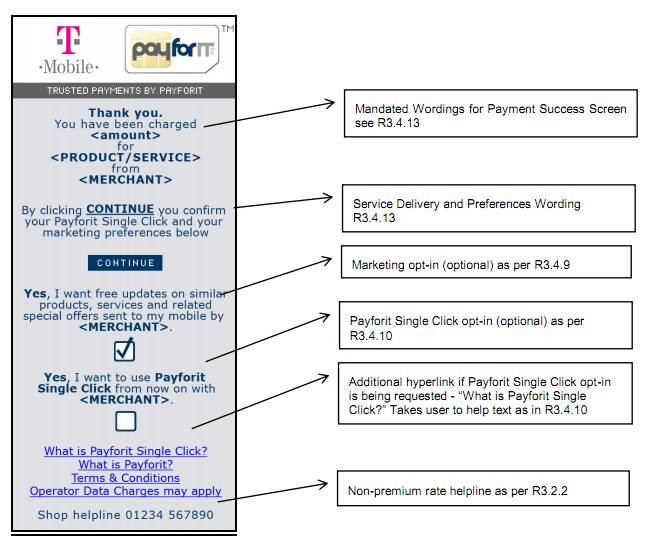
Whenever you want to purchase content and charge it your mobile, you will be presented with a standard Payforit screen that includes clear information on the content/service you are buying, the merchant you are buying from and how much it will cost you. Once you authorise payment by pressing ‘Pay Now’ or ‘Subscribe’, a payment request goes directly to your mobile operator for validation.


4. What are the benefits of using Payforit?
Payforit has been designed to be very simple to use, meaning you can charge items directly to your mobile in a matter of seconds.  There’s no need to send Premium rate text messages to complete a purchase, making it extremely easy and convenient to buy content and services from the mobile internet.


5. Do I need to provide any personal details?
No.  What’s more, you don’t even need to type in your mobile number when you are browsing and shopping on the mobile internet – Payforit automatically detects your number from your mobile network as soon you reach the payment page.


7. Do I need a bank account or credit card to be able to use Payforit?
There’s no need for a bank account or credit card.  Any purchases you make will be charged directly to your monthly phone bill, or deducted from your prepaid credit.


8. Do I need to pay anything for using Payforit?
There are no additional charges for using Payforit, you only pay the price of the content you are purchasing*
*Please note, for downloads, as well as the price of the service you have ordered, you will also be charged browsing costs in accordance with your Operator data tariff.


9. Do I need to sign up for Payforit with my mobile operator?
No, there’s no need to sign up to be able to use the service.  Whenever you see the Payforit symbol on a mobile portal, you simply follow the on screen instructions to pay for your content.


11. Is there a maximum amount for individual Payforit transactions?
Payforit has initially been designed to support low value transactions (‘micropayments’), typically less than £10.


Payforit (2010). Frequently asked questions. Retrieved
 from http://www.payforituk.com/pages/faqs.html#4


The Trusted Mobile Payment Framework exists to promote a safe and trustworthy environment under which mobile phone users may purchase goods and services and charge  the cost  to their mobile phone accounts. It has been constructed under the auspices of the Mobile Network Operator Payforit Management Group („Payforit Management Group‟).


3.7 Payforit Single Click Processing Rules Payforit.
Single Click purchasing is an optional extension to the Payforit scheme that allows for Consumers to choose a more rapid payment method for multiple purchases from the same Merchant on WAP.  The  Consumer must be initially taken through the full Payforit payment flow before they are presented with the option to use Payforit Single Click for their next purchase(s) from the  same Merchant. The sign-up to Payforit Single Click is done on the Payment Success Screens templates using option 5 or 6 (as per R3.4).
Once the  Consumer agrees to use Payforit Single Click for future purchasing  from that Merchant, the Accredited Payment Intermediary will present a small clickable image containing the price of the item directly into the Merchant‟s screen, requiring the  Consumer to click the image to confirm the charge to their account.


Payforit (2010). Trusted Moblie payment framework. Scheme rules. Retrieved from http://www.payforituk.com/docs/Payforit%203.0%20Published%2026%2002%2010.pdf

Thursday, March 10, 2011

How people are making real $ in 2nd Life


Tuesday, March 24, 2009

Top Second Life Entrepeneur Cashing Out US$1.7 Million Yearly; Furnishings, Events Management Among Top Earners

Robin Harper Linden
During a March 9 Silicon Valley forum held at Microsoft's Mountain View campus,recently-departed Linden Lab VP Robin Harper offered some extraordinary financial numbers from Second Life's internal economy: based on a quarterly annualization the company conducted, they discovered that several Resident business owners were cashing out Linden Dollars in excess of a million US dollars a year, with the top earner grossing an estimated $1.7 million.  An initial blog report suggested this top ranking was based on the sale of virtual shoes, which seemed fairly incredible, so I double-checked that point with Robin.  The $1.7 million figure is accurate, she told me by e-mail and in a correction on her blog today, but it's not based on shoes:
"[S]everal people/accounts are cashing out US$ amounts in excess of $1M per year (with the highest amount estimated at $1.7M), based on annualizing one quarter of data. Most of the top 10 are in the real estate business, but the group also includes a company that does events and one that designs virtual goods including shoes." 
Besides the pure wallop of those weighty numbers, two things stand out to me:

Though it's well known that many of SL's land barons are enormously successful, many people have assumed their equity was mainly in the value of the land (i.e. servers) they owned.  (This was the case of Anshe Chung, who claimed in 2006 to be SL's first millionaire, but mostly through her land holdings, which she would have to sell, to truly have a million in US dollars.) Now thanks to Robin, we discover that several land barons are indeed able to cash out that amount, or more.   Equally surprising is the fact that the top ten is not just in real estate, but include virtual fashion/furnishings, and events management.  I'd not have guessed either could reach revenue levels of such heights.  Now follows the immediate speculation: who's doing so well, and how did they get that way?


TrackBack

TrackBack URL for this entry:
http://www.typepad.com/services/trackback/6a00d8341bf74053ef01156f43e571970b

1st virtual world millionare - 2006


Anshe Chung Becomes First Virtual World Millionaire


Parlays $10 investment into million dollar corporation in 30 months


Plush City @ Second Life and Wuhan, China @ Real Life 26-Nov-2006
Anshe Chung has become the first online personality to achieve a net worth exceeding one million US dollars from profits entirely earned inside a virtual world.

Recently featured on the cover of Business Week Magazine, Anshe Chung is a resident in the virtual world Second Life. Inside Second Life, Anshe buys and develops virtual real-estate in an official currency, known as Linden Dollars, which is convertible to US Dollars. There is also a liquid market in virtual real estate, making it possible to assess the value of her total holdings using publicly available statistics.

The fortune Anshe Chung commands in Second Life includes virtual real estate that is equivalent to 36 square kilometers of land – this property is supported by 550 servers or land "simulators". In addition to her virtual real estate holdings, Anshe has "cash" holdings of several million Linden Dollars, several virtual shopping malls, virtual store chains, and she has established several virtual brands in Second Life.  She also has significant virtual stock market investments in Second Life companies.

Anshe Chung's achievement is all the more remarkable because the fortune was developed over a period of two and a half years from an initial investment of $9.95 for a Second Life account by Anshe's creator, Ailin Graef.  Anshe/Ailin achieved her fortune by beginning with small scale purchases of virtual real estate which she then subdivided and developed with landscaping and themed architectural builds for rental and resale. Her operations have since grown to include the development and sale of properties for large scale real world corporations, and have led to a real life "spin off" corporation called Anshe Chung Studios, which develops immersive 3D environments for applications ranging from education to business conferencing and product prototyping.

Ailin Graef was born and raised in Hubei, China, but is currently a citizen of Germany. She runs Anshe Chung Studios with her husband Guntram Graef, who serves as CEO of the company. Anshe Chung Studios has offices in Wuhan, China and is currently seeking to expand its workforce from 25 to 50.  (Pictures of the Wuhan offices are available here).

The valuation of the virtual land holdings is based on property value statistics published by Linden Lab and current simulator prices.  Based on these statistics a valuation of one million dollars in virtual assets is conservative, and the actual value may be significantly higher.

This estimate only includes the valuation of the avatar Anshe Chung's virtual assets at current market rates. It does not include the real world assets of Anshe Chung Studios. It also does not include any valuation based on expected revenue, expected profits or any other intangible business equity (such as brand value or good will). It does not include assets owned in other virtual worlds such as IMVU,There or Entropia Universe.

Anshe Chung and Anshe Chung Studios are independent and not affiliated with other entities such as virtual world platform operators or marketing firms. Anshe Chung Studios is fully owned by Anshe Chung's creator and her partner and has been wholly financed from virtual world profits.

Above all, Anshe Chung stresses the importance of community in her vision of the virtual worlds and work spaces that she and others are pioneering together.  Her goal is not merely to build a corporation, but to foster the development and growth of online communities, and to help make the entry of real world corporations into Second Life and other regions of the metaverse as frictionless as possible.  It is her philosophy that Second Life is above all a social space, and that corporate entrants that respect the community will be the most successful.

Anshe Chung will be available to answer questions by the media on a press conference in Mengjing @ Second Life scheduled for Tuesday 28th November at 9 am PST. For special media inquiries please contact media@anshechung.com. Please understand that Anshe Chung Studios is in a phase of rapid growth and that ACS will have to prioritize media requests.

Linden Lab - 2nd Life Creators


1 Billion Hours, 1 Billion Dollars Served: Second Life Celebrates Major Milestones for Virtual Worlds

Linden Lab Shares Statistics Revealing Tremendous User Engagement and the Largest User-Generated Virtual Goods Economy in the World


SAN FRANCISCO — September 22, 2009 — Linden Lab®, creator of the virtual worldSecond Life®, today announced that Second Life Residents have transacted the equivalent of more than one billion US dollars with each other while spending more than one billion hours in Second Life – significant milestones for the virtual worlds industry. The company also shared a series of additional statistics that reveal the scale of Second Life and its virtual goods economy, as well as the activity and engagement of its Residents.

From its inception, Second Life has offered a rich three-dimensional environment that is built upon and fueled by the collective imagination and ingenuity of its Residents. Representing nearly every country and hundreds of cultures from around the globe, the Second Life community uses the virtual world as a place to create, connect, collaborate, communicate, and more across barriers of language and physical location. The combination of a world without boundaries and a highly engaged user base has led to a number of key milestones for Second Life. Some of these accomplishments include:
  • In total, users around the world have spent more than one billion hours in Second Life. 
    That's roughly 115,000 years spent doing everything from meeting and socializing with friends; to attending live concerts; to creating, selling, and shopping for virtual goods; to learning a foreign language; to attending business meetings; and much more. User hours grew 33% year-over-year to an all-time high of 126 million in Q2 2009.
  • Second Life Residents spend an average of about 100 minutes inworld per visit.
    This average session time is significantly greater than those seen with popular social networking websites and reveals the uniquely high level of engagement Residents have with Second Life.
  • The equivalent of more than USD1 billion has been transacted between Residents in Second Life, who purchase virtual goods and services from one another. 
    The inworld economy grew 94% year-over-year from Q2 2008 to Q2 2009. Now at nearly USD50 million each month in user-to-user transactions, the Second Life economy is on an annual run rate of more than a half billion US dollars, making Second Life the largest virtual economy in the industry.
  • Residents create more than 250,000 new virtual goods every day – from clothing to vehicles to buildings to automatic language translators, and more.
    There are now more than 270 terabytes of content in Second Life, and this is growing by approximately 100% every year.
  • More than 18 billion minutes of voice chat have been used in Second Life since voice was introduced in 2007.
    Voice minutes grew 44% year-over-year from Q2 2008 to Q2 2009, and more than six billion minutes of voice have been delivered in 2009 alone, making Linden Lab a major VoIP provider.
  • Approximately 1,250 text-based messages are sent every second in Second Life, and more than 600 million words are typed on an average day.
    Roughly 60% of active Second Life Residents based outside of the US, representing more than 200 countries, and the Second Life Viewer available in 10 languages.
  • The total land area of Second Life is now equivalent to approximately two billion square meters – roughly the size of the state of Rhode Island.
    Land in Second Life has grown roughly 18% from Q1 of 2009 and approximately 75% since Q1 of 2008. As the creator and original seller of all virtual land in Second Life, Linden Lab is not only the provider of the worlds largest platform for user-generated virtual goods, but also a leading virtual goods vendor itself.

Industry-leading content creation and transactional tools, coupled with the fact that Residents retain the IP rights to the content they build inworld, have enabled Second Life Residents to make Second Life a leading hub of user-generated content (UGC) and the largest user-generated virtual goods economy in the world. The unique content Residents create and sell in Second Life makes the virtual world a more compelling experience for individuals and a more useful platform for enterprises and educators, as well as providing an entrepreneurial opportunity for content creators who can profit from their creations.

A wide variety of activity makes up the more than 40 million hours Residents spend in Second Life each month. For example, Residents meet and socialize with friends while exploring unique environments, dancing at live music performances, visiting art galleries, learning new languages, sailing the virtual seas, and building new creations. Entrepreneurs around the globe have built successful businesses in Second Life, selling their virtual goods and services to others and earning real profits. Hundreds of universities and real world businesses, including many of the Fortune 500, are using Second Life as a platform for learning and training, meetings and events, and collaboration and prototyping.

"These metrics give a sense of some key aspects of Second Life – the deeply engaging nature of the 3D world, the immense use of Second Life as a communications platform, and the scale and strength of the economy based on the huge number of unique virtual goods users are creating," said Mark Kingdon, CEO, Linden Lab. "These numbers are a snapshot of the success of Second Life and its Residents today, and a validation of Linden Lab's leadership in the virtual worlds space, but there's much more to come. This is a year of renovation for Second Life, and we're well positioned for reinvigorating our growth in 2010 with a range of strategic initiatives that will enhance the experience for existing Residents and propel our expansion with new users."


About Second Life and Linden Lab 
Developed and launched by Linden Lab in 2003, Second Life is the world's leading 3D virtual world environment. It enables its Residents to create content, interact with others, launch businesses, collaborate, educate, and more. Since its inception, Second Life Residents have logged more than one billion user hours and generated more than USD1 billion in user-to-user transactions. With a broad user base that includes everyone from consumers and educators to medical researchers and large enterprises, Second Life has become one of the largest hubs of user-generated content and the largest user-generated virtual goods economy in the world.
Linden Lab, founded in 1999 by Chairman of the Board Philip Rosedale and headquartered in San Francisco, develops revolutionary technologies that change the way people communicate, interact, learn and create. Privately held and profitable, Linden Lab is led by CEO Mark Kingdon, and has more than 300 employees spread across the U.S., Europe, and Asia.


Media Contacts:
LEWIS PR for Linden Lab

Tel: (415) 992-4434
secondlifeus@lewispr.com